


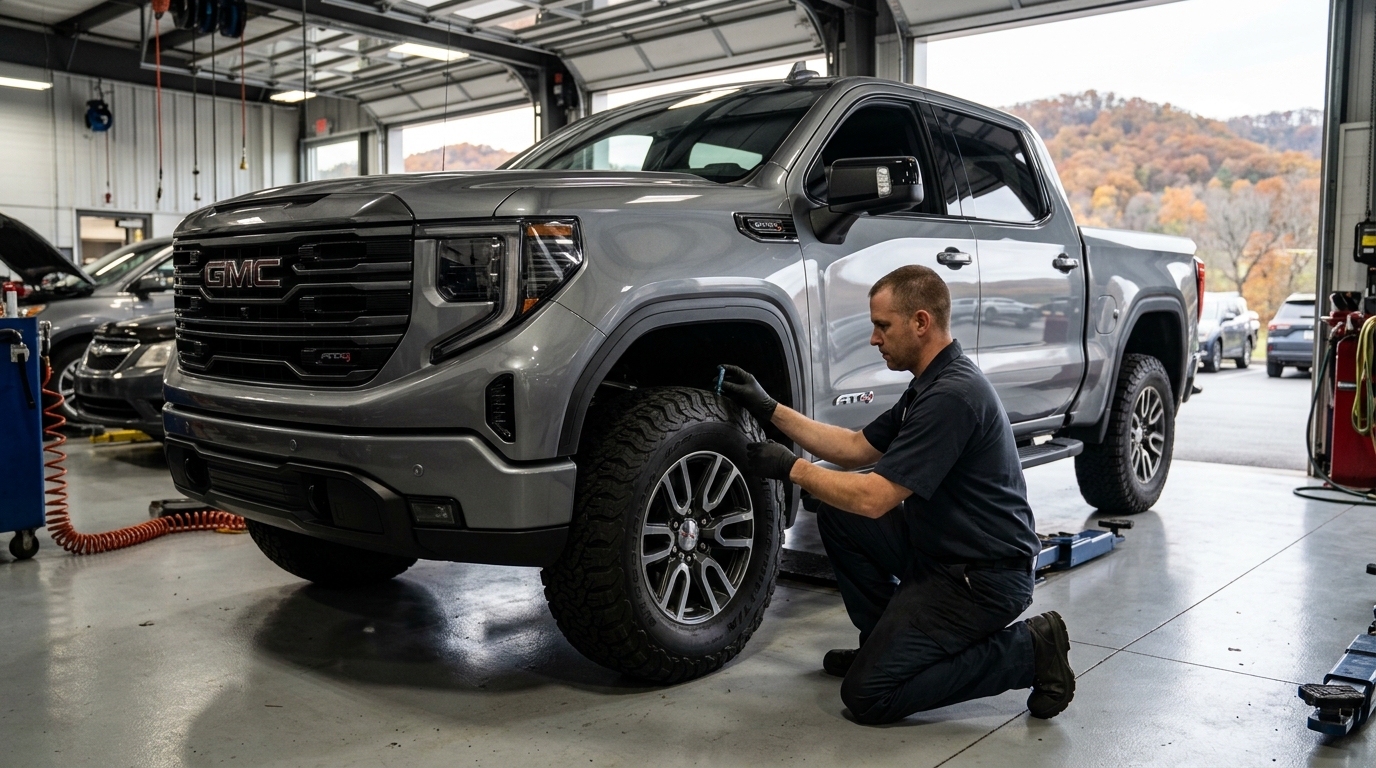
 As a Service Manager here at Rusty Wallace GMC with over 10 years of experience keeping trucks and SUVs running safely year-round, I know how quickly seasonal weather shifts bring unique challenges to our roads. Preparing your vehicle for fall and winter requires targeted maintenance that addresses tire grip, cooling system protection, battery capacity, and undercarriage defense before cold temperatures arrive.
Standard factory tire sizes for the GMC Sierra 1500 typically range from 265/65R18 on off-road-capable models like the AT4 to 275/60R20 on highway-oriented builds. While standard all-season tires carry an M+S rating suitable for light rain and mild autumn temperatures, navigating freezing conditions or steep mountain grades demands tires stamped with the 3-Peak Mountain Snowflake ( 3PMSF) emblem, which certifies measured traction performance in severe snow testing.
Many truck owners ask whether factory all-season tires offer sufficient grip when cold weather sets in. Standard all-season tread compounds begin to harden when ambient temperatures drop below 45 degrees Fahrenheit, reducing rubber flexibility and contact patch friction. On the moderately hilly terrain in Morristown, where shaded road patches frequently turn to black ice during early morning commutes, relying on hardened rubber increases stopping distances significantly. Equipping your truck with 3PMSF-rated all-weather tires or dedicated winter tires ensures the tread block pliability required to maintain directional control on frozen surfaces.
If you want expert advice on matching the proper tire specification to your trim level or driving habits, give our team a quick call or check our dealership location for interactive driving directions.
Table of Contents
- What Winter Tire Tread Depth and Pressure Are Recommended for GMC Sierra and Yukon Models?
- What Items Are Checked During a GMC Certified Service Multi-Point Winter Inspection?
- What Engine Coolant Protection Level and Block Heater Usage Are Required for GMC Duramax Diesels?
- Should You Turn Off GMC StabiliTrak or Traction Control When Stuck in Deep Snow?
- What Winter Wiper Blades, Washer Fluids, and Safe Frame Undercoatings Protect Your GMC Vehicle?
- How Do You Schedule Seasonal Maintenance at Rusty Wallace GMC?
What Winter Tire Tread Depth and Pressure Are Recommended for GMC Sierra and Yukon Models?
GMC recommends maintaining a minimum winter tire tread depth of 4/32 inch for light-duty trucks and full-size SUVs to ensure effective slush evacuation and snow traction. Cold ambient temperatures reduce tire inflation pressure by approximately 1 psi for every 10-degree Fahrenheit drop, making it essential to set cold inflation pressures strictly according to the driver-door placard specification rather than waiting for a tire pressure monitoring system warning.
While the legal minimum tread depth across most highway standards sits at 2/32 inch, that remaining groove depth is insufficient for displacing winter slush or heavy rain standing in road ruts. On heavier vehicles like a GMC Sierra 1500 or GMC Yukon, shallow tread allows a wedge of water or packed snow to build under the tire, inducing hydroplaning or slide events at moderate speeds. Checking tread depth with a dedicated gauge across the inner, center, and outer tread ribs ensures even wear and adequate channel volume.
Proper inflation management is equally vital when autumn transitions into winter. Checking tire pressure when the vehicle has been parked for at least three hours provides an accurate baseline reading. Running underinflated tires in cold weather causes excessive shoulder wear, degrades fuel efficiency, and compromises handling stability during sudden emergency maneuvers.
What Items Are Checked During a GMC Certified Service Multi-Point Winter Inspection?
A GMC Certified Service multi-point winter inspection thoroughly evaluates critical cold-weather operational systems, including battery cranking capacity, DEX-COOL freeze point and fluid quality, brake pad thickness, tire tread depth and inflation pressure, belt and hose elasticity, wiper blade integrity, and suspension component wear.
When truck and SUV owners bring their vehicles into our service drive ahead of freezing weather, the single most common concern I hear centers on battery reliability. Cold weather severely reduces a battery's chemical efficiency while simultaneously increasing the cranking power required to turn over a cold engine oil reserve. Technicians conduct conductance testing to measure cold cranking amps against original equipment specifications, identifying aging cells before they fail on an unexpectedly frosty morning.
Beyond electrical testing, technicians inspect heating and defrosting performance, verify that fluid reservoirs are filled with freeze-resistant formulas, and check underneath the vehicle for leaking shocks or worn ball joints. You can easily schedule your winter multi-point inspection online and browse our current service and parts specials to keep seasonal maintenance convenient and affordable.
What Engine Coolant Protection Level and Block Heater Usage Are Required for GMC Duramax Diesels?
GMC Duramax diesel engines require a precise 50/50 mix of GM-approved DEX-COOL coolant and clean distilled water, which provides freeze protection down to -34 degrees Fahrenheit and boil-over protection up to 265 degrees Fahrenheit. The factory engine block heater should be plugged into a grounded power source whenever ambient temperatures fall below 0 degrees Fahrenheit, though plugging it in at 15 degrees Fahrenheit substantially eases cold-cranking effort and accelerates cabin heater operation.
Maintaining the exact concentration ratio of DEX-COOL coolant is critical because diluted mixtures elevate the freeze point, risking severe internal engine block or radiator damage if fluid crystallizes inside cooling passages. Conversely, running an overly concentrated coolant mixture reduces heat transfer efficiency, leading to higher operating temperatures during heavy towing or hauling tasks. Using distilled water prevents mineral deposits from coating internal heat exchangers and water pump seals over long-term operation.
For diesel powertrains, such as the available 3.0L Duramax turbodiesel offered in the 2026 GMC Sierra 1500 AT4, engine block heaters maintain warm oil and coolant jackets overnight. Warm oil flows instantly upon startup, reducing cylinder wall wear and reducing glow plug duty cycles during initial ignition. Using an outdoor appliance timer set for two to three hours before your morning commute provides full thermal benefits without unnecessarily drawing electricity all night long.
Should You Turn Off GMC StabiliTrak or Traction Control When Stuck in Deep Snow?
You should temporarily turn off Traction Control by pressing the console button when stuck in deep snow, slush, or mud to allow intentional wheelspin, which helps clear tire tread voids and builds momentum to rock the vehicle free. Once the vehicle regains momentum and moves back onto a clear or packed road surface, Traction Control and the overarching StabiliTrak electronic stability system should be re-engaged immediately.
Under normal driving conditions, Traction Control monitors wheel speed sensors and automatically reduces engine torque or applies selective braking when it detects a slipping wheel. While this system is invaluable on slick pavement, it can completely halt vehicle movement when attempting to pull out of deep snow bank accumulation because it continuously cuts throttle power as the tires attempt to bite. Disabling traction management allows the tires to spin, throwing packed snow out of the tread grooves so the rubber can reach underlying traction.
When operating 4WD models like the 2026 GMC Sierra 1500 AT4 or 2026 GMC Yukon AT4, utilizing low-speed off-road technologies complements proper driver intervention. Engaging the two-speed Autotrac transfer case in 4-Auto or 4-High locks drive power across both axles, while selecting Terrain mode optimizes throttle mapping for low-speed maneuvering. Additionally, features like Hill Descent Control manage automatic brake application to maintain steady downhill control on slippery grades without locking up the wheels.
What Winter Wiper Blades, Washer Fluids, and Safe Frame Undercoatings Protect Your GMC Vehicle?
GMC recommends fitting beam-style winter wiper blades encased in protective rubber boots alongside washer fluid rated for at least -20 degrees Fahrenheit to prevent windshield icing and maintain clear forward vision. Frame protection against road salt and liquid de-icers should consist of non-hardening, lanolin-based or oil-based rust inhibitors, which penetrate seam welds and frame cavities without trapping moisture or degrading factory rubber bushings and wiring harnesses.
Standard wiper blades quickly clog with wet snow and ice in freezing rain, causing the metal frame superstructure to freeze stiff and leave wide unswept streaks across the glass. Beam-style winter blades utilize a continuous curved spring steel structure protected inside a sealed boot, ensuring uniform pressure across the glass surface. Combining these blades with low-temperature washer fluid prevents the fluid from freezing instantly upon contact with a cold windshield during high-speed highway driving along I-40 near Knoxville.
Undercarriage protection requires careful product selection to avoid damaging critical chassis components. Traditional rigid rubberized undercoatings tend to dry out over time, developing hairline micro-cracks that trap salt-laden water directly against steel frame rails and aluminum suspension linkages, accelerating hidden corrosion. Lanolin and petroleum oil barrier coatings remain self-healing, actively creeping into tight body seams and unpainted frame sections while remaining completely safe for rubber body mounts, electrical loom conduit, and sensor wiring.
How Do You Schedule Seasonal Maintenance at Rusty Wallace GMC?
Reserving your seasonal winter prep service at Rusty Wallace GMC takes just a few moments online or over the phone with our dedicated service team. Staying ahead of winter maintenance ensures your vehicle maintains factory reliability, optimal fuel economy, and maximum safety throughout the coldest months of the year.
Our factory-trained technicians use genuine GM parts, factory diagnostic tools, and model-specific procedures to inspect, service, and protect your truck or SUV. Whether you need a fresh cooling system charge, a comprehensive battery test, a new set of 3PMSF winter tires, or an oil change before seasonal road trips, our service department delivers prompt, professional care tailored to your vehicle.
Reach out to our service advisors directly at (423) 586-1441 to discuss your winter maintenance needs, or plan your trip using our service center location map to visit us in person. We look forward to keeping your GMC operating at its peak all season long.