



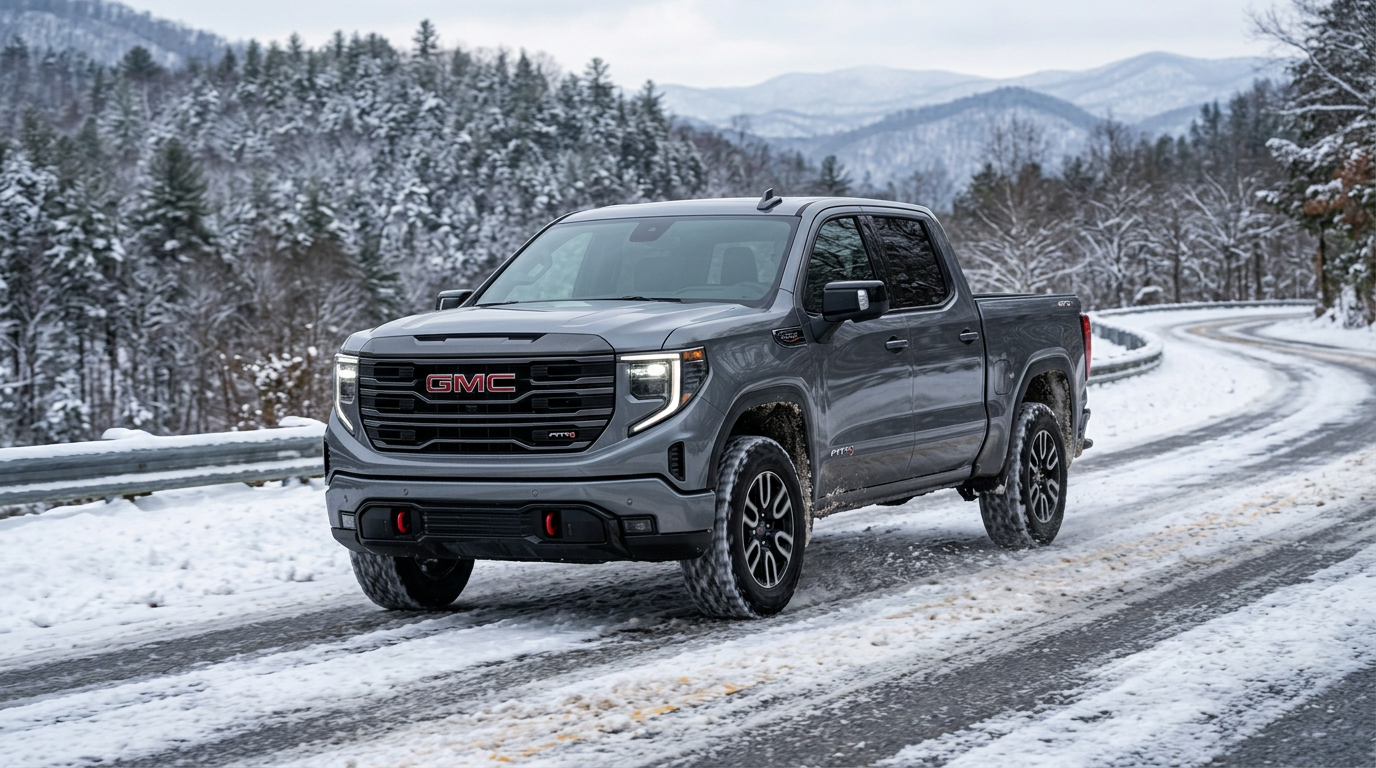
 GMC Autotrac automatic 4WD mode operates continuously in rear-wheel drive until onboard wheel-speed sensors detect slippage, at which point an electronically controlled multi-plate wet clutch instantly engages the transfer case to route torque to the front driveshaft. Once front-wheel traction is restored and rear-wheel slip ceases, the system automatically disengages front-wheel power, helping optimize fuel economy while reducing the risk of mechanical drivetrain binding on dry asphalt patches.
For drivers navigating the moderately hilly terrain of the Ridge-and-Valley Appalachians around Morristown, winter driving often involves moving back and forth between dry highway asphalt and shaded, ice-covered back roads. In these mixed conditions, selecting Auto mode on the dash-mounted transfer case dial provides real-time slip protection without requiring driver intervention. The system continuously monitors individual wheel rotation rates, engine throttle position, and steering angle to determine exactly when torque biasing is required. When rear wheels begin spinning on a slushy incline or bridge deck, power transfers forward within milliseconds.
Unlike traditional four-wheel-drive High mode, which mechanically locks the front and rear driveshafts together at a fixed 50/50 power split, Autotrac in Auto mode allows the front and rear axles to rotate at slightly different speeds during turns. This prevents the harsh steering-wheel resistance and tire scrubbing known as drivetrain binding, which occurs when a locked 4WD system operates on dry or semi-dry pavement. Consequently, truck owners can leave the vehicle in Auto throughout the winter months when road conditions vary minute by minute.
While Auto mode excels in variable winter weather, severe off-road situations or unplowed deep snow drifts still call for dedicated low-range or locked modes. When navigating thick mud or deep mountain snow banks at low speeds, switching to 4HI or 4LO engages the transfer case clutch fully to deliver equal, unyielding torque to both drive axles. To ensure your transfer case fluid and electronic actuators are fully prepped for freezing temperatures, stop by our dealership map location for a complete drivetrain inspection, or give our service technicians a quick call to discuss seasonal maintenance.
Table of Contents
- What Are the Best 3PMSF-Rated Tires for a GMC Sierra 1500?
- What Cold Cranking Amp Battery Rating Is Needed for East Tennessee Winters?
- What Is the Ideal Cold-Weather Tire Pressure and TPMS Setup for a GMC Sierra?
- What Is the Maximum Recommended Speed When Driving in 4HI on a GMC Sierra?
- What Winter Weather Features and Emergency Kit Items Belong in Your GMC Truck?
- Frequently Asked GMC Truck Winter Maintenance Questions
What Are the Best 3PMSF-Rated Tires for a GMC Sierra 1500?
The three-peak mountain snowflake ( 3PMSF) rating indicates that an all-terrain or winter tire meets standardized severe snow traction testing standards, delivering significantly better grip on snow and ice than standard mud-and-snow ( M+S) all-season tires. For a GMC Sierra 1500, top-rated 3PMSF tire options include the Goodyear Wrangler DuraTrac, the BFGoodrich All-Terrain T/A KO2 or KO3, and the Michelin LTX A/T2, each engineered to handle heavy payloads while conquering freezing road surfaces.
Selecting the right 3PMSF tire depends on your typical driving balance between highway commuting, off-road traction, and deep snow biting capability. The Goodyear Wrangler DuraTrac features aggressive shoulder blocks and proprietary TractiveGroove technology that traps snow within the tread channels, creating snow-on-snow traction that excels in unplowed driveways and muddy timber trails. For drivers who demand maximum sidewall puncture resistance on gravel routes, the BFGoodrich All-Terrain T/A KO2 uses CoreGuard sidewall rubber and interlocking tread elements with integrated stone ejectors to maintain steady grip across packed ice and jagged rock.
Truck owners prioritizing highway comfort, reduced cabin noise, and long tread life alongside cold-weather safety often prefer the Michelin LTX A/T2. This tire utilizes advanced rubber compounding that remains pliable in sub-freezing temperatures without wearing down prematurely during warmer winter spells. Pairing any of these high-traction tires with the GMC Sierra's available G80 auto-locking rear differential ensures that engine power translates directly into forward momentum, even when one rear wheel loses traction completely on slick ice.
Maintaining proper tire tread depth is critical for winter driving safety in East Tennessee, as worn tread channels cannot evacuate slush or packed snow effectively. When tread depth drops below 4/32 inches, winter braking distances increase dramatically on wet or frozen pavement. You can maintain optimal safety and extend tread life by scheduling service online for a tire rotation, balance, and tread depth evaluation before winter storms arrive.
What Cold Cranking Amp Battery Rating Is Needed for East Tennessee Winters?
Full-size GMC trucks and SUVs require a battery rated for a minimum of 700 CCA to 800 CCA (Cold Cranking Amps) to reliably start in sub-freezing winter conditions. Models equipped with heavy-duty engine packages or extensive electrical accessories, such as the 2026 GMC Yukon XL, come equipped from the factory with an upgraded 730 CCA battery to handle the extra electrical draw of heated seats, defroster grids, and high-output starter motors.
Cold Cranking Amps measure the total current a 12-volt battery can deliver for 30 seconds at 0 degrees Fahrenheit while maintaining a minimum voltage of 7.2 volts. As ambient outdoor temperatures drop toward freezing, chemical reactions inside the battery slow down significantly, reducing its available output power by up to 50 percent. At the exact same time, cold engine oil thickens inside the engine block, creating substantial mechanical resistance that forces the starter motor to draw significantly more amperage to turn the crankshaft.
Full-size trucks operated across rural agricultural routes around Jefferson City require robust battery reserves when parked outside overnight near open lake basins. In addition to high CCA ratings, modern GMC trucks benefit from Absorbent Glass Mat ( AGM) battery technology. AGM batteries resist vibration damage, recharge faster after short trips, and maintain higher terminal voltage under heavy electrical loads compared to traditional flooded lead-acid designs.
To prevent cold-weather starting failures, truck owners should have their battery tested before the first severe cold snap. A comprehensive battery check evaluates terminal corrosion, cold cranking delivery, and alternator charging output.
- CCA Delivery Test: Verifies the battery can meet or exceed its factory amp rating under simulated load.
- State of Charge Inspection: Measures resting terminal voltage to detect internal cell degradation.
- Terminal and Cable Cleaning: Removes lead-sulfate corrosion to ensure maximum electrical conductivity.
- Parasitic Drain Check: Ensures aftermarket electronics do not drain the battery while the truck is parked.
What Is the Ideal Cold-Weather Tire Pressure and TPMS Setup for a GMC Sierra?
The ideal tire pressure for a GMC Sierra during winter driving is the exact cold inflation pressure listed on the vehicle's driver-side door jamb placard, which typically specifies 35 PSI to 40 PSI depending on the factory wheel size and payload rating. Tire pressure drops by approximately 1 PSI for every 10-degree Fahrenheit decrease in ambient temperature, meaning a sudden cold front can trigger low pressure alerts if tires are not adjusted seasonally.
GMC Sierra trucks monitor inflation levels using an integrated Tire Pressure Monitoring System ( TPMS) that displays individual tire pressures directly on the digital driver information center. To set tire pressures accurately in winter, always measure inflation when the tires are cold, meaning the truck has been parked for at least three hours or driven less than one mile. Never adjust winter tire pressure to match the maximum inflation limit molded onto the tire sidewall, as that figure reflects the structural limit of the tire carcass rather than the vehicle's optimal vehicle load specs.
To simplify cold-weather inflation, GMC trucks come equipped with Tire Fill Alert technology. When adding air to a tire with the ignition on, the system provides audible horn chirps and exterior light flashes the moment the correct cold pressure target is reached, eliminating the need to constantly check a manual pressure gauge in freezing weather.
Running under-inflated tires in winter causes excessive heat buildup on tire shoulders, compromises steering response, and reduces fuel economy. Conversely, over-inflating tires reduces the size of the contact patch, decreasing available traction on ice and snow-covered roadways. Checking cold tire pressures at least once a month ensures maximum safety, optimal tread wear, and predictable vehicle handling throughout the winter season.
What Is the Maximum Recommended Speed When Driving in 4HI on a GMC Sierra?
A commonly recommended speed range when driving in 4HI (4WD High) on a GMC Sierra is 45 to 50 mph, provided that road conditions are consistently covered in snow, slush, or loose gravel. Operating in 4HI locks the front and rear driveshafts together electronically through the transfer case, providing maximum traction but limiting the vehicle's ability to absorb rotational speed differences between the front and rear axles during highway cornering.
Driving in 4HI at elevated speeds on patchy or partially cleared pavement generates severe heat inside the transfer case, subjects CV joints to high mechanical stress, and can cause unpredictable vehicle handling if tires lose and regain grip suddenly. When traveling on dry or variable highways where speeds exceed 50 mph, drivers should switch out of 4HI and select Auto mode or 2HI.
- 2HI (Two-Wheel Drive): For dry, clear pavement; maximizes fuel economy and minimizes drivetrain wear.
- Auto (Automatic 4WD): Ideal for patchy snow, wet highways, and variable ice; engages front axle automatically upon wheel slip.
- 4HI (Four-Wheel Drive High): For sustained snow, heavy slush, or unpaved roads at speeds below 50 mph.
- 4LO (Four-Wheel Drive Low): Reserved strictly for severe low-speed extraction, steep inclines, or deep mud under 25 mph.
Truck owners coming into our shop during late fall frequently ask how the automatic drive mode handles sudden black ice patches on shaded ridge roads without causing mechanical binding. Our technicians always explain that Auto mode delivers the perfect balance of instant traction response and component protection, making it the safer, smoother choice for mixed winter highway travel compared to continuous 4HI operation.
What Winter Weather Features and Emergency Kit Items Belong in Your GMC Truck?
Modern GMC trucks offer a comprehensive suite of winter convenience and safety features engineered to maintain driver visibility, cabin warmth, and maximum tire traction during severe cold spells. Features such as remote vehicle start are standard equipment on trims including the SLE, Elevation, SLT, AT4, AT4X, and Denali. Remote start pre-conditions the engine and cabin, automatically engaging heated front seats and the heated steering wheel when ambient cabin temperatures drop below freezing.
In addition to cabin comfort tech, mechanical features like heated power-folding mirrors melt ice off side glass, while the G80 auto-locking rear differential automatically locks both rear wheels together whenever a speed difference of 100 RPM or more is detected between them. This provides instant, mechanical push without requiring driver input when pulling out of snow-banked parking spaces or slippery boat ramps.
Even with advanced vehicle technology, carrying a dedicated winter emergency kit in your truck cab or under-seat storage compartment is an essential safety precaution.
- Vehicle Recovery Tools: Heavy-duty tow straps, traction boards, and a compact folding snow shovel.
- Emergency Power: Jumper cables or a portable lithium-ion jump-starter pack rated for full-size truck engines.
- Visibility and Lighting: LED flashlight with extra batteries, reflective safety vest, and high-visibility road flares.
- Warmth and Shelter: Thermal wool blankets, insulated work gloves, winter hats, and hand warmer packets.
- Fluids and Maintenance: Extra bottle of winter-grade windshield washer fluid rated to -20 degrees Fahrenheit and a heavy-duty ice scraper with brass blade.
Checking fluid levels, topping off low-freeze washer fluid, and ensuring wiper blades are free of torn rubber elements are simple pre-winter inspection steps that prevent dangerous visibility loss during heavy mountain snowfall.
Frequently Asked GMC Truck Winter Maintenance Questions
Q: How often should I check my truck's battery voltage during winter?
You should test your truck's battery voltage at least once before winter begins and check terminal connections monthly throughout the cold season. A fully charged 12-volt battery should read 12.6 volts or higher when the engine is off. If resting voltage drops below 12.2 volts, the battery is undercharged and may fail during a severe freeze. Our service center uses specialized digital battery testers to measure cold cranking capacity under load, identifying failing cells before they leave you stranded.
Q: Can I use regular windshield washer fluid during East Tennessee winters?
No, standard summer windshield washer fluid can freeze solid inside the washer reservoir, fluid lines, and spray nozzles when temperatures drop below 32 degrees Fahrenheit. Freezing fluid can crack the plastic washer fluid reservoir and damage the electric pump motor. Always refill your fluid reservoir with a winter-formula washer fluid rated for at least -20 degrees Fahrenheit before freezing weather arrives. Winter formulas contain alcohol additives that melt light windshield frost while preventing line freeze.
Q: Why does my tire pressure warning light turn on on cold mornings?
Your TPMS light turns on cold mornings because air contracts as temperatures drop, decreasing tire pressure by approximately 1 PSI for every 10-degree Fahrenheit drop in ambient air temperature. If your tires were inflated to 35 PSI during 70-degree fall weather, a drop to 30-degree morning temperatures will lower internal pressure to roughly 31 PSI, triggering the TPMS alert. Inflating your tires to the recommended door-jamb PSI when cold resolves the warning.
Q: What is the difference between GMC Auto 4WD and AWD?
GMC Auto 4WD is a feature of a true four-wheel-drive system with a two-speed transfer case, allowing the driver to select between 2HI, Auto, 4HI, and 4LO. In Auto mode, the truck drives in two-wheel drive until rear slippage occurs, then engages a clutch to send power forward. All-Wheel Drive ( AWD) systems operate continuously without a low-range transfer case or manual mode selection dial, distributing power between axles automatically at all times.
Q: How do I prepare my GMC truck engine for sub-freezing temperatures?
Preparing your engine for sub-freezing weather requires verifying coolant protection levels, checking engine oil viscosity, and inspecting belt tension. Coolant should be mixed at a 50/50 ratio of DEX-COOL anti-freeze and distilled water, providing freeze protection down to -34 degrees Fahrenheit. Additionally, using the factory-recommended synthetic oil weight ensures rapid oil circulation to upper valvetrain components during cold engine starts, minimizing internal engine wear.
To ensure your vehicle is fully prepped for winter conditions, visit our service department location for professional maintenance, or give our certified technicians a call at (423) 586-1441 to schedule your seasonal inspection today.
© 2026 Rusty Wallace GMC. All rights reserved.
Categories:
Social